


Filters

Agentic AI in HR
 Download


Recommended For You
Frequently Asked Questions
Find answers to common questions about this content
Talent Acquisition Leader / Recruiting Leader
Why is agentic AI particularly relevant for modern talent acquisition environments?
Agentic AI suits dynamic talent environments where roles and skills evolve rapidly. It handles incomplete data and ambiguous goals by reasoning through complexity and adjusting strategies in real time. This flexibility supports recruiting leaders facing shifting workforce plans and unpredictable hiring needs, helping reduce time to hire and improve candidate matching without relying on perfect data.
What capabilities should I look for to identify true agentic AI in recruiting tools?
Look for AI that can autonomously select and execute tools, troubleshoot and correct course, retain short- and long-term memory of preferences and past decisions, and maintain context-aware decision-making. True agentic AI adapts mid-task, monitors for redundancies or ethical concerns, and provides clear reasoning behind its actions. These features support complex recruiting workflows better than scripted or single-shot prompt systems.
How does agentic AI maintain memory of past interactions in recruiting workflows?
Agentic AI retains preferences, past decisions, and contextual cues over time. For example, it remembers a hiring manager’s preferred interview scheduling times without needing reminders in every workflow. This memory supports smoother, more personalized recruiting processes and reduces repetitive manual input.
What should I expect in terms of investment and complexity when building agentic AI for recruiting?
Developing agentic AI requires significant investment to build multi-layered systems coordinating dozens of specialized processes in parallel. The AI must not only execute tasks but evolve as it works. This complexity means building agentic AI internally demands substantial resources and expertise, which may influence whether to build or buy a solution.
Recruiter
What is agentic AI and how does it differ from traditional automation in recruiting?
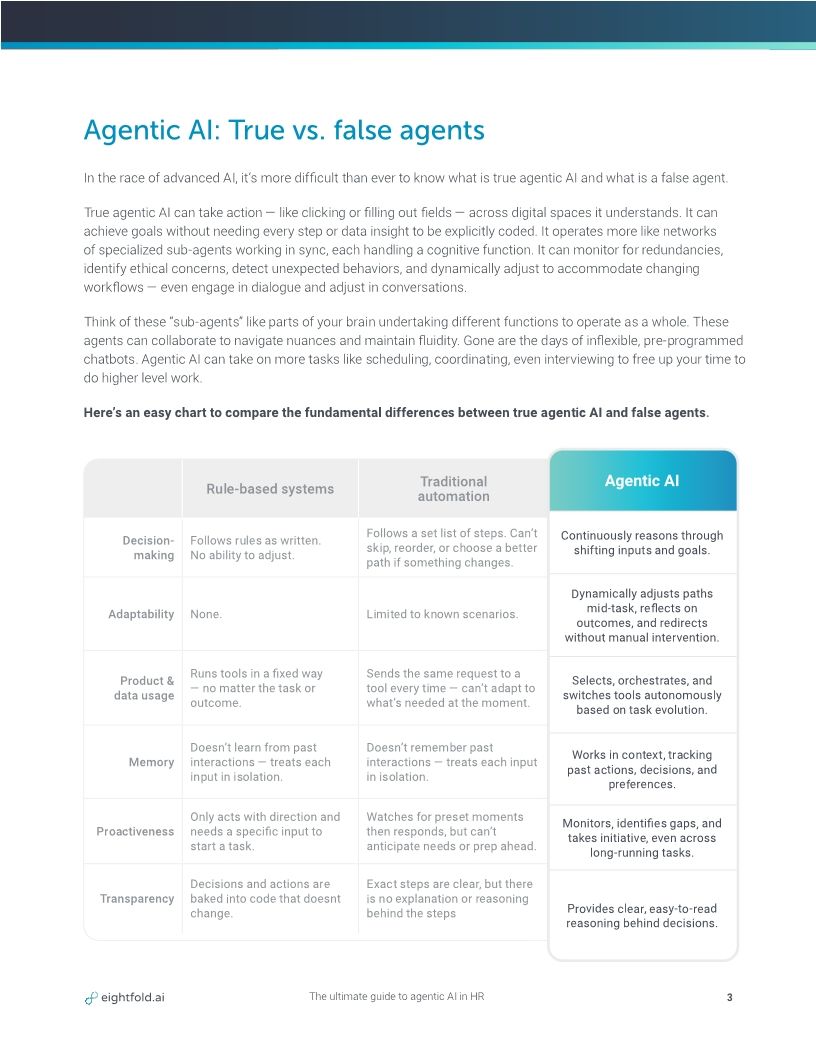
Agentic AI differs from traditional automation by adapting to changing workflows and reasoning through complex tasks without fixed rules. Unlike rule-based systems that follow preset steps, agentic AI can adjust mid-task, remember past interactions, and proactively manage recruiting activities like scheduling or interviewing. This flexibility helps recruiters handle dynamic talent environments where roles and skills evolve constantly.
How does agentic AI handle workflow changes during recruiting tasks?
Agentic AI dynamically adjusts workflows mid-task without manual intervention. It can reroute processes if a tool fails, reprioritize based on candidate feedback, and pause or shift focus between topics. This flexibility helps recruiters manage unpredictable hiring scenarios and maintain pipeline health without rigid, pre-programmed steps.
What kind of decision-making flexibility does agentic AI provide during candidate interactions?
Agentic AI maintains flexible, non-linear workflows that can pause deep dives, reprioritize topics, or shift focus based on candidate responses. This allows it to adapt interviews or assessments in real time, supporting more natural and effective candidate engagement compared to rigid scripted systems.
What should I expect in terms of investment and complexity when adopting true agentic AI?
Developing or adopting true agentic AI requires significant investment due to its multi-layered architecture coordinating many specialized processes in parallel. The system not only executes tasks but evolves as it works, demanding careful planning and integration with existing recruiting workflows to realize its full benefits.
HR / Talent Management Leader
Why is agentic AI particularly relevant to modern enterprise talent environments?
Agentic AI suits dynamic talent environments because it handles incomplete information, ambiguous goals, and constant change. It helps reduce time to hire and improves candidate matching by reasoning through complexity and adjusting strategies in real time, unlike static systems that rely on perfect data or fixed workflows.
How does agentic AI handle changes or failures during talent workflows?
Agentic AI detects misalignments or redundancies and can course-correct without stopping. If a tool fails, it reroutes and selects alternatives autonomously, regenerating outputs. This flexibility ensures continuous progress in workflows like scheduling or interviewing, reducing friction and manual oversight in complex talent operations.
How does agentic AI integrate with existing HR tools and data sources?
Agentic AI operates across digital spaces it understands, autonomously selecting and orchestrating tools or third-party applications as needed. This flexibility supports integration with various HR systems and data sources, enabling continuous adjustment without relying on predefined paths.
How does agentic AI support change management and adoption in complex HR environments?
Agentic AI reduces friction by adapting workflows dynamically and handling recursive talent work that revisits priorities. Its ability to reason and adjust in real time helps minimize disruption to existing processes, supporting smoother adoption and integration.
Hiring Manager
What is agentic AI and how does it differ from traditional automation in HR?
Agentic AI differs from traditional automation by adapting to changing workflows and reasoning through complex tasks. Unlike rule-based systems that follow fixed steps, agentic AI can adjust mid-task, remember past interactions, and proactively manage hiring activities like scheduling or interviewing. This flexibility helps in dynamic talent environments where roles and skills evolve rapidly.
How does agentic AI improve handling of dynamic and unpredictable hiring workflows?
Agentic AI adapts to shifting contexts and incomplete information by reasoning through complexity and adjusting strategies in real time. It can reprioritize tasks, pause deep dives, and manage hierarchical topics, which supports hiring managers in navigating evolving candidate responses and changing role requirements.
What are the key features of agentic AI that support complex hiring tasks?
Key features include multi-step reasoning that breaks goals into dynamic subtasks, autonomous tool selection, troubleshooting and course correction, and context-aware decision-making. These enable the AI to adapt to changing candidate interactions, detect redundancies, and maintain flexible workflows, which are critical for hiring managers managing end-to-end processes.
How can agentic AI reduce friction in scheduling and interview coordination?
Agentic AI remembers preferences like a hiring manager’s preferred interview times, reducing the need for repeated reminders. It autonomously manages scheduling tasks and can adjust dynamically if conflicts arise, helping hiring managers save time and reduce coordination delays.